william vetzal

With the impact of the “Roots” television series many people of Ukrainian background in North America began to search for their ethnic roots. William Vetzal was one of these people. A second generation Ukrainain-Canadian now living in Whitby, Bill, as he is called was a tool and die maker by trade and worked for General Motors as a Precision Inspector. Bill with his wife Margaret began to investigate their family roots and origins. On his fathers side, he discovered that on the Vetzal side his grandfather Ivannes Wecal was from Zelena. just south of Sklat. On his mothers side his grandfather Karol Baran was from from Horodnytcia just a little further south , both small villages in the Ternopil region of Western Ukraine. Both families came to Canada in the early 1900’s. His research has turned up four generations of ancestors going back to the 1750’s his list has over 2,000 individuals. As his grandparents would say “these are all our brothers and sisters”.. His interest stimulated him to learn the language and the literature, and it was here that he discovered the beauty of Shevchenko’s poetry published in the Kobzar. Bill was intrigued by the powerful historic role of the minstrel-like kobzar in Ukrainian culture and decided to make an example to hang up on the wall of his home, along with the many other amazing artistic creations he had made during his life.
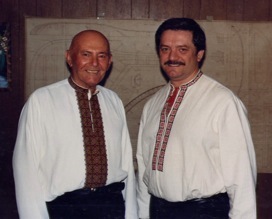
Bill spent a considerable amount of time with Alex, who because of a heart condition was no longer able to make banduras. Together with his brother Peter, they had in the 1940’s been pioneers in the development of the modern concert bandura. Bill was able to observe 40 years of instrument making skills, learning many of the secrets in making an exceptional instrument. After building his first three instruments, he returned to show Alex his work. He was thrilled to see that Bill had retained the quality he had in his workmanship and told him “ I can now retire again and I will recommend you to whoever needs a Bandura”.
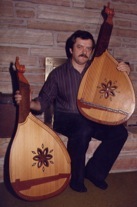
Continued research, development, and access to some of the latest articles on instrument construction have helped Bill produce a hardier and even better sounding instrument. The superiority of these instruments is attested to by the fact that the Ukrainian Bandurist Chorus in Detroit ordered instruments from Bill.
After the historic tour of Ukraine in 1991 by the Ukrainian Bandurist Chorus, great interest in Bill’s designs was shown by prominent bandurists in Ukraine, Since then he has received numerous requests for information and orders from Ukraine.
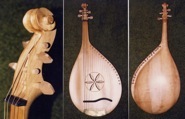
Between a hundred to a hundred and fifty hours goes into preparing and finishing a bandura of concert quality. The concert Karkiv bandura must have every string strung in an extremely precise manner, A specially developed mechanism is placed on the bridge for precise retuning. Fine instruments leave no margin for error.
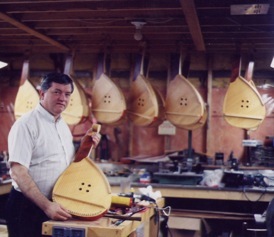
Bill’s workshop is amazing. In order to make the bandura as inexpensive as possible, he has been able to apply his knowledge of tooling in designing and building equipment to duplicate the many parts for the bandura. He has designed a carving machine to carve out the backs of the bandura from solid wood, using a model to help guide the cutter, thus duplicating the same shape every time. He has also made a machine to make precision-wound strings for each of his instruments. Bill has made precision dies to help punch out the metal parts on his press for manufacture of mechanisms for this concert bandura. With his son Steve, he has devised computer formulas to predict the optimum tension, string diameter including the various differences in core and windings, which would produce the most pleasing sound. He has also made templates to manufacture hard-cases for his instruments.
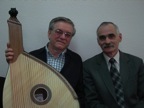
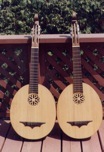
He has restored numerous historic Ukrainian folk instruments to their original specifications and repaired a countless number of damaged banduras.
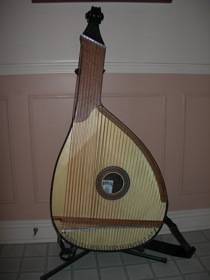
Realizing that fiberglass instruments being built in the United States and Canada are very successful, every thing pointed to bring this technology to bandura making. It took 1 year of building the mould and experimenting with the resins and cloth. In the second year after retiring from General motors Bill had more time to devote to the project. Building one instrument at a time, evaluating the changes that were made to the previous instrument and incorporating it into the next one. A total of 12 instruments were cast from the first mould. It was a long and drawn out process, but the instrument was greatly improved. One of the big problems was the amount of string tension on the instrument, this forced the addition of back ribbing, adding to the total weight of the instrument, which increased to 11.5 lb. The goal is to reduce it to 10 lb. with the use of other products for the second build which will include a new mould.
In 2007 Bill celebrated 25 years of building Bandura’s by traveling across Ukraine, visiting his ancestral villages and meeting many new friends in Kharkiv, Kiev, Ternopil and Lviv. He plans to start casting a second round of instruments in 2008.
my story